
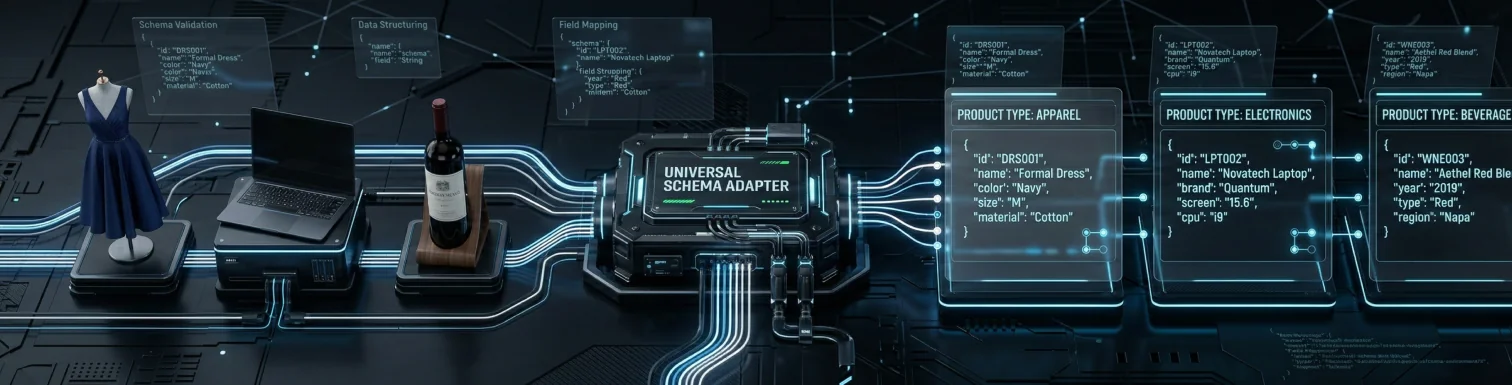
Schema-Driven Everything: How Customers Define Their Own Content: Building merchi.ai Chapter 7
The Flexibility Paradox of 2026 E-Commerce
As we progress through 2026, the retail landscape has shifted from a “web-first” model to a “headless-everywhere” reality. Consumers are no longer just browsing websites; they are interacting with products via augmented reality mirrors, voice-activated kitchen hubs, and autonomous shopping agents. For a merchandising engine like merchi.ai, this presents a significant challenge: how do you build a single system that can generate high-quality content for a luxury silk scarf, a high-torque industrial drill, and a pack of organic sourdough crackers, all while ensuring the data is perfectly structured for a dozen different endpoints?
The traditional approach to PIM (Product Information Management) systems was rigid. You had a “Title” field, a “Description” field, and perhaps a handful of custom attributes. But in the current era of “Zero-Click Commerce,” where structured data is the only language AI agents understand, this rigidity is a death sentence for scaling. If a merchant wants to launch a new category that requires “Allergen Info” or “Technical Compatibility,” they shouldn’t have to wait for a developer to update the database schema. They need the power to define their own content structures on the fly.
This led us to a core architectural decision for merchi.ai: Schema-Driven Everything. We realised that our platform shouldn’t decide what a product listing looks like; our customers should. By building a configurable schema system, we’ve created a “merchandising canvas” where users define their own content “blocks.” These blocks act as the DNA of the product listing, telling our AI exactly what to generate, what to extract, and what to ignore.
This flexibility is what allows us to deliver on our promise of processing 125 years of human labour in a single day. Whether a retailer has 10,000 SKUs in fashion or electronics, they use the exact same merchi.ai infrastructure, but with radically different schemas. This chapter dives into the mechanics of how we’ve turned content structure into a configurable asset that drives AI intelligence.
Content Blocks: The Building Bricks of a Brand
In the merchi.ai ecosystem, the fundamental unit of configuration is the “Content Block.” A block isn’t just a text field; it is a container for logic, rules, and assets. When a customer sets up their Writing Knowledge configuration, they define a schema comprised of these blocks; such as “Technical Specifications,” “Styling Advice,” or “SEO Metadata.” This modular approach allows for infinite customisation without compromising the stability of our underlying data pipeline.
Each block within the schema is governed by a set of “Generation Rules.” These are specific instructions that tell the AI how to behave for that particular field. For instance, a “Care Instructions” block might have a rule to “always include water temperature and drying restrictions,” while a “Benefits” block might be told to “prioritise emotive, lifestyle-driven language over technical specs.” By attaching these rules to individual blocks, we provide the AI with a granular map of the merchant’s expectations.
Beyond rules, blocks can also contain “Attached Assets.” These serve as reference points: style guides, examples of “gold standard” copy, or specific manufacturer PDFs. When the merchi.ai engine assembles a prompt for a specific block, it pulls in these assets to provide the LLM with context. This ensures that the generated content isn’t just “good,” but is perfectly aligned with the brand’s established aesthetic and technical standards.
We support a variety of field types within these blocks, including strings, arrays (for bulleted lists), and complex objects for nested data. This allows for highly structured outputs that can be mapped directly to a retailer’s existing ERP or e-commerce platform. By treating content as a collection of structured blocks rather than a single blob of text, we empower retailers to deliver consistent, high-fidelity data across every sales channel they operate in.
Industry-Specific Schemas: One Engine, Infinite Voices
The true power of the merchi.ai schema system is most visible when comparing how different industries utilise the platform. Because the schema is per-tenant, the AI’s “personality” and focus shift entirely based on the blocks defined by the customer. This industry-agnostic flexibility is why merchi.ai has become the preferred choice for massive retailers who manage diverse portfolios of brands.
| Retailer Type | Core Content Blocks | Logic Focus |
|---|---|---|
| Fashion | Title, Description, Styling Advice, Fabric Composition, Care Instructions | Emotive language, material nuance, aesthetic curation. |
| Electronics | Title, Description, Technical Specs, Compatibility, Features & Benefits | Technical accuracy, data-driven comparisons, rigid specs. |
| Food & Grocery | Title, Description, Ingredients, Nutritional Info, Allergens, Storage | Regulatory compliance, safety-first data, clear instructions. |
For a fashion retailer, the focus is often on the “soul” of the garment. Their schema will prioritise blocks like “Styling Advice,” which uses our Writing Knowledge to suggest complementary items or occasions. For a hardware or electronics store, the schema shifts toward “Technical Specs” and “Compatibility,” where the AI is instructed to be clinical and precise, extracting chuck sizes or voltage requirements from raw images or manufacturer CSVs.
In the grocery sector, the stakes are even higher. A “Nutritional Info” block might include strict validation rules to ensure allergens are clearly highlighted and regulatory standards are met. By using the same underlying automation logic but switching the schema, merchi.ai can pivot from being a lifestyle copywriter to a technical engineer or a compliance officer in milliseconds. This is the industrial-scale flexibility that 2026 e-commerce demands.
The Structured Intelligence: From Schema to JSON
How does a customer’s UI configuration translate into an AI output? This is where our Prompt Assembly logic (discussed in Chapter 4) and our schema system converge. When a processing run is initiated, merchi.ai takes the schema definition and transforms it into a set of structured instructions for the LLM. We don’t just ask the AI to “write a description”; we ask it to “output a JSON object that strictly adheres to the following keys and rules.”
By forcing the AI into a JSON-native workflow, we eliminate the need for fragile post-processing or manual data cleaning. The schema defines the “Contract” between our engine and the AI. If the schema specifies that “Technical Specs” must be an array of objects with key and value properties, our assembly logic ensures the prompt includes that specific schema definition. The AI then returns a structured response that we can validate, store, and sync immediately.
We also utilise “Passthrough Fields” for data that should not be touched by the AI. SKUs, base prices, and stock levels are critical data points that must remain deterministic. By including these in the schema as passthrough fields, they travel alongside the AI-generated content throughout our pipeline, ensuring that the final output is a complete, ready-to-publish product listing. This prevents the “split-data” problem where generated copy and core metadata live in separate, disconnected systems.
This schema-driven approach is vital for the rise of autonomous shopping agents. These bots don’t want to read a beautiful paragraph to find out if a camera is compatible with a specific lens; they want to query a compatibility array. By generating data that is structured from the moment of inception, merchi.ai ensures that our customers’ products are the most “discoverable” assets in the 2026 digital economy.
The Governance Challenge: Validation and UI
Building a system that allows non-technical users to define complex data schemas is a massive UX challenge. We had to create an interface: the merchi.ai Schema Builder, that feels as intuitive as a drag-and-drop website builder but generates the rigorous JSON-schema logic required by our backend. This UI must handle field types, generation rules, and asset attachments without overwhelming the merchandising teams who use it daily.
Governance is another critical factor. When a customer evolves their brand and wants to change their schema (perhaps adding a “Sustainability Score” block), we have to manage that transition without breaking existing data. merchi.ai uses a Schema Versioning system. Every processing run is tied to a specific version of the tenant’s schema. This allows us to track exactly which rules were in place when a particular product was generated, providing an audit trail that is essential for enterprise compliance.
Validation is the final piece of the puzzle. Even with strict prompts, LLMs can occasionally “break” the JSON structure or omit required fields. Our Trigger.dev workers include a validation step where the AI output is checked against the customer’s schema. If the output is malformed, the system triggers an automatic retry with a “Correction Prompt,” telling the AI exactly what it got wrong in the previous attempt. This “Self-Correction” loop is what ensures our reliability remains at 99.9%.
Ultimately, schema-driven merchandising is about empowerment. It’s about giving the power of data architecture to the people who actually understand the products: the merchandisers and brand managers. By removing the technical bottleneck of hardcoded fields, merchi.ai allows brands to move at the speed of the 2026 market, launching new categories and channels in hours rather than months.
What’s Next?
We’ve now seen how customers define the structure of their content. But in a globalised economy, structure is only half the battle. You also need language. In Chapter 8, we will explore the merchi.ai philosophy of Multi-language Generation. We’ll explain why we never use “translation” and why generating content natively in eight different languages is the only way to maintain a brand’s soul across borders.
Ready to build a content schema that actually fits your business? Book a Demo or Start Automating for FREE with merchi.ai.