
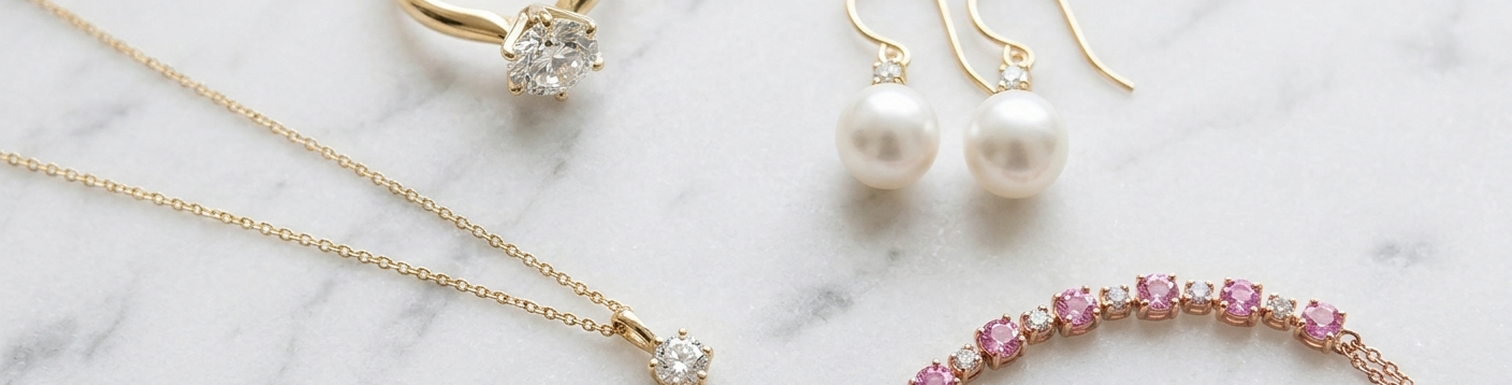
AI Product Content for Jewellery and Accessories Retailers: Hallmarks, Gemstone Data, and Sizing at Scale
Jewellery is one of the most trust-sensitive categories in retail. A buyer purchasing a piece described as 18ct gold expects 18ct gold. A buyer selecting a diamond ring from a product page needs to know the stone’s cut, clarity, colour, and carat weight before they commit to a high-value purchase. A buyer with a nickel sensitivity relies on hypoallergenic declarations to make a safe choice. When product content in jewellery is inaccurate or incomplete, the consequences are not merely returns and negative reviews. In some cases they are trading standards and consumer protection issues.
The product content challenge in jewellery retail is not simply the volume of SKUs, though that is real enough in a category where a single fine jewellery retailer may stock thousands of individual pieces. It is the specificity of the data each piece requires, and the inconsistency with which that data arrives from suppliers and manufacturers. This guide covers what accurate, complete jewellery product content looks like across the main sub-categories, and how a configurable AI content schema manages it at scale.
Hallmarking: UK legal requirements for precious metals
UK law requires that most precious metal articles offered for sale in the UK bear a hallmark applied by one of the four UK Assay Offices (London, Edinburgh, Birmingham, Sheffield) or an approved overseas hallmarking authority. The hallmark confirms the metal’s fineness (purity) independently of any claim made by the manufacturer.
For product content, the hallmark data that must appear on the product page includes:
Metal type and fineness: Gold is described by carat (9ct = 375 parts per thousand, 14ct = 585, 18ct = 750, 22ct = 916). Silver is described by millesimal fineness (925 = sterling silver, 999 = fine silver). Platinum is described as 850, 900, 950, or 999. Palladium as 500, 950. The carat or fineness value is the legally meaningful data point, not a marketing description.
Assay Office: UK buyers who know the hallmarking system look for the Assay Office mark as a provenance indicator. The London Goldsmiths’ Hall mark (a leopard’s head), Edinburgh (castle), Birmingham (anchor), and Sheffield (Yorkshire rose) each carry distinct associations. Accurately recording and presenting the Assay Office on the product page is straightforward when the hallmark data is stored as a structured field.
Vermeil and gold-filled: These descriptions are sometimes used loosely by suppliers. Vermeil is sterling silver with a minimum 2.5 micron layer of gold over it. Gold-filled has a mechanically bonded gold layer of at least 1/20th of the total weight. Gold-plated has no minimum thickness requirement. These are legally distinct descriptions in a consumer context, and a product page that uses them interchangeably invites Trading Standards attention.
A schema for UK jewellery retail includes dedicated fields for metal type, fineness, hallmarking authority, and surface treatment (vermeil, gold-filled, plated, solid), with validation logic that prevents incompatible combinations from being published. A piece cannot simultaneously be described as “solid 9ct gold” and “gold-plated”.
Gemstone data: the four Cs and beyond
Diamond product descriptions in fine jewellery retail require structured gemstone data that buyers use for comparison and valuation. The four Cs (cut, colour, clarity, carat weight) are the internationally recognised quality parameters, each with a defined grading scale.
Cut: Graded by the Gemological Institute of America (GIA) as Excellent, Very Good, Good, Fair, or Poor. Cut quality directly affects brilliance and fire. Buyers at the upper end of the market distinguish between Excellent and Very Good. A product description that says “beautifully cut” without a GIA cut grade is not providing the data that buyers in this price bracket expect.
Colour: Graded on a D-to-Z scale from colourless (D) to light yellow or brown (Z). Colourless to near-colourless (D–J) command premium pricing. Buyers who know the scale search by colour grade. A schema field for colour grade enables filtering and accurate description.
Clarity: Graded from Flawless (FL) to Included (I1, I2, I3). Internally Flawless (IF), Very Very Slightly Included (VVS1, VVS2), Very Slightly Included (VS1, VS2), and Slightly Included (SI1, SI2) represent the grades most commonly found in retail fine jewellery.
Carat weight: Expressed as a decimal (0.50ct, 1.02ct). For multi-stone pieces, total carat weight (TCW) is declared alongside individual stone weights where relevant.
Beyond diamonds, coloured gemstones require additional disclosure. Treatment declarations are a significant content obligation in the coloured stone market. Heat treatment of sapphires and rubies, fracture filling of emeralds, and irradiation of certain coloured stones are industry-standard processes, but buyers are entitled to know whether a stone has been treated. A product page that describes a sapphire as “natural” without disclosing heat treatment may not meet Consumer Contracts Regulations expectations for accurate pre-purchase information.
A schema with dedicated gemstone fields (stone type, origin where declared, treatment status, certification body) handles this systematically. Where gemological certification exists (GIA, AGL, Gübelin), the certificate reference should be included as a structured field rather than buried in a description paragraph.
Hypoallergenic status: a purchase qualification criterion
For a significant proportion of jewellery buyers, particularly in the earrings and body jewellery market, hypoallergenic status is a purchase qualification criterion. Buyers with nickel contact allergies specifically look for pieces made from surgical steel (316L or 316LVM), titanium (ASTM F136 implant grade), niobium, or solid 18ct gold. They actively avoid brass, copper, and most silver alloys, which may contain nickel or trigger reactions in sensitive individuals.
The EU Nickel Directive (Directive 94/27/EC, now the REACH Regulation) sets maximum nickel release limits for items intended for prolonged skin contact. UK law retained equivalent requirements post-2021. Earrings, necklaces, and bracelets sold in the UK must not release nickel in excess of 0.2 micrograms per square centimetre per week.
For product pages, this means two things. First, pieces that meet the surgical steel or titanium standard should declare the specific alloy grade (316L, ASTM F136) rather than the generic term “hypoallergenic”, which has no legal definition. Second, pieces that do not meet the standard should not use “hypoallergenic” at all.
A schema that includes a structured hypoallergenic field with defined permitted values (316L surgical steel, ASTM F136 titanium, 18ct solid gold, sterling silver, other with note) enables buyers to filter by material, and ensures declarations are consistent and accurate across the catalogue.
Ring sizing: UK conventions and international conversion
Ring sizing in the UK uses an alphabetical system (A through Z and beyond). International markets use different systems: the US/Canada uses numerical sizes (typically 3–13 for women, 8–14 for men), Europe uses internal diameter in millimetres, Japan uses a separate numerical scale, and France/Spain/Italy use yet another numerical scale.
For a UK retailer selling domestically, product pages should present sizes in UK letters as the primary format. For a UK retailer with international traffic, the product page should ideally present the UK size with conversion information or a sizing tool. Where a product is manufactured overseas and supplied with US or EU sizing, the conversion should be applied consistently rather than leaving the original sizing system on the product page and requiring buyers to self-convert.
A schema with structured size fields and conversion lookup logic handles this cleanly. The product editor enters the manufacturer’s native size format, the schema converts to the correct presentation format for the target market, and the product page presents sizes in the format buyers expect.
Chain and bracelet specifics
Chain products require attribute data that is distinct from other jewellery categories:
Length: expressed in centimetres or inches, with typical UK convention being centimetres. Chain length descriptions should note the clasp style (lobster claw, spring ring, toggle, box), since clasp choice affects the effective wearing length and the security of the piece.
Chain style: Belcher, Figaro, snake, box, Venetian, curb, rope, trace, and wheat are the main styles found in UK retail. Each has distinct visual characteristics and weight-per-length properties. Buyers searching for a specific chain style use these terms, and a product page that describes a chain only by length and metal type loses that search traffic.
Width: expressed in millimetres, and important for pendant compatibility. A pendant designed for a 3mm box chain will sit differently on a 1mm trace chain. Where pendant and chain are sold as a set, compatibility should be declared.
A schema with dedicated chain fields (length, style, width, clasp type) applied consistently across the chain catalogue enables filtering and ensures the product description addresses the attributes buyers search for.
How merchi.ai handles jewellery product content at scale
The data requirements described above are well understood by most jewellery buyers and merchandising teams. The gap is not knowledge: it is execution. A team managing a catalogue of two thousand pieces from fifteen suppliers, each delivering data in a different format at a different level of completeness, cannot manually apply structured hallmark fields, gemstone grading data, hypoallergenic declarations, and size conversions to every SKU and keep pace with new stock.
merchi.ai solves this with a configurable AI content schema built to the specific attribute model of jewellery and accessories retail.
Structured extraction from supplier data. When a supplier sends a spreadsheet describing a diamond ring as “18k yellow gold, brilliant cut diamond, D/VS1, 0.75ct, GIA 2345678”, merchi.ai extracts each value into the correct structured field: metal type, fineness, gemstone type, cut grade, colour grade, clarity grade, carat weight, certificate reference. No manual re-keying. No inconsistency across batches from different suppliers.
Attribute extraction from imagery. For pieces where supplier data is sparse, merchi.ai reads product imagery to identify metal colour, stone type (where visible), setting style, and chain type. This matters in a category where brands frequently supply high-quality photography before complete data sheets arrive.
Sub-category schema configuration. Fine jewellery, fashion jewellery, and accessories require different attribute models. A schema configured for fine jewellery handles hallmark fields, the four Cs, treatment declarations, and certification references. A schema for fashion jewellery handles hypoallergenic material data, trending descriptors, and outfit-pairing context. A schema for accessories handles material composition, dimensions, and hardware specifications. Each sub-category gets the right fields, not a generic template.
Validation logic that prevents compliance errors. The schema applies rules that prevent contradictory or incomplete declarations from being published: a piece cannot be described as solid 18ct gold and gold-plated simultaneously; a hypoallergenic claim requires a valid underlying material; a GIA certificate reference triggers the requirement for all four C fields to be populated.
Catalogue velocity. New stock is described and published on the day it arrives. Seasonal collections go live complete, not in a phased trickle as content catches up with buying. Product pages that were placeholder descriptions become fully attributed, searchable, and compliant entries that convert at the rate the product deserves.
For retailers with existing PIM or ecommerce platforms, merchi.ai integrates into the existing workflow. Output is delivered in the format the platform expects, so enriched product data slots directly into Shopify, Magento, or any catalogue management system without a reformatting step. See how merchi.ai integrates with your tech stack for more detail, and AI product attribution for how attribute extraction works across image and data inputs.
Talk to us about your jewellery catalogue
If you manage product content for a jewellery or accessories range and are dealing with inconsistent supplier data, incomplete attribute fields, or a backlog of undescribed stock, book a call to see how merchi.ai’s pipeline handles jewellery-specific schemas.
Or start a 30-day free trial and run it on your own product data.
Internal links
- AI product content for watch retailers: movement types, water resistance ratings, and complication data for watch product pages
- AI product content for luxury fashion retailers: provenance, authentication, and premium product content
- Configurable AI product content schema: how the attribute model adapts to different product categories
- What is AI product attribution?: how AI extracts structured attributes from product data and images
- AI retail merchandising hub: platform overview
Frequently Asked Questions
Does AI product content handle UK hallmarking requirements automatically?
A correctly configured schema treats hallmark data as structured fields with defined permitted values: metal type, fineness in parts per thousand, Assay Office, and surface treatment (solid, vermeil, gold-filled, plated). Validation logic prevents incompatible combinations from being published. Where supplier data supplies a description rather than structured hallmark data, AI extracts the structured values from the text. Where hallmark data is missing entirely, the schema flags the SKU for review rather than publishing an incomplete or inaccurate description.
Can AI product content include diamond grading data from GIA certificates?
Yes. Where a GIA certificate number and grading data are supplied with the product, the AI schema maps the certificate data to structured fields: cut grade, colour grade, clarity grade, and carat weight. The certificate reference number is stored as a structured field and presented on the product page. For retailers who do not routinely stock GIA-certified diamonds, the schema includes the same fields without the certificate reference, populated from supplier specification data.
How does AI handle hypoallergenic declarations across a mixed metals catalogue?
Hypoallergenic status is a structured field with defined permitted values that reflect the material basis for the claim (316L surgical steel, ASTM F136 titanium, 18ct solid gold) rather than a free-text marketing description. A piece is only marked as hypoallergenic where the underlying material data supports that claim. Generic “hypoallergenic” tags applied inconsistently across a catalogue are one of the most common trading standards risks in jewellery retail. A structured approach prevents the term from being applied to pieces whose metal composition does not meet the threshold for that claim.
How does AI product content handle ring sizing for international retailers?
The schema stores size data in the manufacturer’s supplied format and converts to the required presentation format for each target market using a standard sizing conversion table. For UK market presentation, UK alphabetical sizes are the default output. Where sizing conversion is approximate (as all international ring sizing conversions are, due to rounding), the product page notes the conversion method and links to a sizing guide rather than presenting a false precision.
Can AI product content generate accurate descriptions for coloured gemstones, including treatment disclosures?
Yes, where treatment data is supplied in the product information. Treatment status (none, heat treated, fracture filled, irradiated) is stored as a structured field and reflected in the product description and specification table. Where a supplier does not supply treatment data, the schema flags the gemstone field as requiring verification before publication, since omitting treatment disclosure for treated stones is a consumer information risk. AI does not infer treatment status from visual data alone.