
AI Product Content for Pet Retailers: Managing Species, Life Stage, and Safety Data at Scale
Pet retail looks deceptively simple from the outside. The categories are familiar: food, toys, beds, accessories, healthcare. What is not obvious until you are managing the catalogue is the sheer attribute complexity that underpins every single SKU.
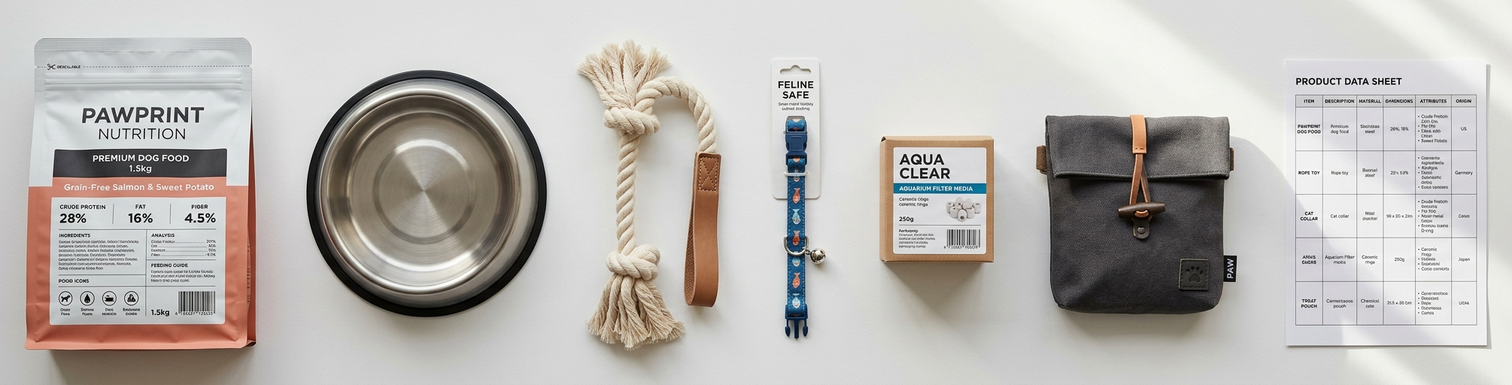
A dog food entry is not one product. It is a matrix. The same product line may run across six species, four life stages, three breed-size categories, and eight health conditions, each with distinct analytical constituents, feeding guides, ingredients lists, and pack sizes. A mid-sized online pet retailer stocks tens of thousands of SKUs across this matrix, and every one needs accurate, complete, consistent product content to rank in search, convert browsers into buyers, and comply with UK labelling and trading standards requirements.
This is the environment where generic AI content tools break down. Generating a compelling description for a dog toy is straightforward. Generating accurate, regulation-compliant content for a prescription veterinary diet (including analytical constituents to the correct decimal precision, additives in the correct declaration format, and a feeding guide calibrated to the correct weight bands) requires a product content system built around configurable schemas and category-specific attribute models. This guide covers what that looks like across every major pet product category.
The multi-species problem
The fundamental challenge in pet content is that species creates parallel attribute universes. A collar for a dog and a collar for a cat share the same product type, but the attributes that matter differ in ways that are consequential for both conversion and safety.
A dog collar needs: material, width (mm), adjustable neck circumference range (cm), closure type (buckle, martingale, slip), and whether it carries reflective strips for night visibility. A cat collar needs all of those, plus a break-away or quick-release safety buckle (a critical safety feature that prevents strangulation if the collar catches on something). Listing a cat collar without confirming break-away safety is not just an incomplete product page; it is a potential welfare issue that erodes buyer trust.
This pattern repeats across every category. A dog bed and a cat bed share dimensions, material, and washability. A rabbit bed adds chew-safe material to the list, because rabbits will eat their bedding. An aquarium heater that works for tropical fish is unsuitable for coldwater fish. A flea treatment dosed for a 10-20kg dog should not be used on a cat. These distinctions have to be in the product content, accurately, across thousands of SKUs.
AI product content handles this through species-specific schema configuration. Rather than one generic “pet product” template, the schema defines a distinct attribute model for each species, and within species, for each product category. The system applies the right model automatically based on how each SKU is categorised.
Pet food: the regulatory data layer
Pet food is the most attribute-dense and most regulated category in pet retail. UK pet food sold through retail channels must comply with the requirements of Assimilated Regulation 767/2009 (feed for pet animals), which defines what information must appear on labelling and, by extension, on product pages.
The required data for a complete pet food product page includes:
Analytical constituents: crude protein, crude oils and fats, crude fibre, crude ash, and moisture (for wet food only). These must be expressed as percentages to a specified precision. The values are nutritionally meaningful. A buyer managing a dog with liver disease or chronic kidney disease will cross-check the protein and phosphorus levels before purchasing, and they will choose a retailer whose product pages carry accurate data over one that does not.
Composition (ingredients list): ingredients in descending order of weight before processing, using the appropriate category grouping rules. “Meat and animal derivatives (min. 26% chicken)” is a different declaration format from “fresh chicken (26%)”, and buyers notice the difference. Accuracy here is not optional.
Nutritional additives: vitamins (A, D3, E expressed in IU/kg or mg/kg), preservatives (if added), and any other regulated additives with their E-number designations.
Feeding guide: calibrated to the animal’s weight range (e.g. 5-10 kg body weight: 150-220g per day), with a note on adjustment for activity level and neutered status where relevant. The feeding guide for a wet food pouch is expressed differently from the feeding guide for a 15kg bag of dry kibble.
Species and life stage declaration: the product is suitable for (dog, cat, rabbit, etc.) and for which life stage (puppy/kitten, adult, senior, all life stages, working dogs, breeding females).
Producing this data correctly and consistently across a catalogue that adds dozens of new SKUs every week from multiple brand partners (each delivering data in a different format) is structurally impossible with a manual content team.
Life stage and health condition variants
Beyond the core species split, life stage and health condition create further attribute variation within a single product line.
A premium dog food brand might offer the same core recipe across: puppy (small breed), puppy (medium breed), puppy (large breed), adult (small breed), adult (medium breed), adult (large breed, active), adult (large breed, sensitive digestion), adult (weight management), senior (7+, small breed), senior (7+, large breed). Each variant has a different analytical constituent profile, a different feeding guide, and different recommended portion sizes. All of them need their own product page. All of them need accurate content.
A configurable AI content schema handles this by treating life stage and condition as input variables. The same underlying schema generates accurate, variant-specific content for each SKU from structured product data, rather than producing one generic description and manually editing it twelve times.
Safety attributes and certification
Toy and accessory categories require safety attributes that carry real consumer protection significance.
Dog toys: material (natural rubber, TPR, rope, plush, latex), non-toxic certification (BPA-free where applicable), suitability by chewer type (light, moderate, power/heavy chewer), and whether small parts are present that make the toy unsuitable for unsupervised play. A toy labelled as suitable for heavy chewers that is not is a choking hazard. The product page has to be accurate.
Cat toys: interactive vs solo play, whether feathers or small components are included (which affects supervised-only recommendations), wand attachment compatibility.
Dog harnesses for car travel: an increasingly important category. Some harnesses carry independent crash test ratings (e.g. tested to FIA 8286-2 standard at external facilities). Where this certification exists, it should be on the product page. Where it does not, the page should not imply crash protection. The distinction matters to the buyer and carries liability implications for the retailer.
Pet carriers and crates: species, maximum animal weight, internal dimensions (L x W x H), airline cabin approval (IATA compliant dimensions for the relevant airline size class), ventilation, door type, and whether the carrier is approved for car travel by the seatbelt slot size.
Aquatics: a category of its own
Aquatics is the most technically distinct pet sub-category and the one where generic AI product content most consistently fails.
The attributes that matter for aquarium products are entirely unlike those for dog or cat products. A fish keeper evaluating a filter does not care about material or life stage. They care about: tank volume compatibility (the filter is rated for tanks up to X litres), flow rate (litres per hour), filter media type (biological, mechanical, chemical), noise level (for bedroom tanks), and whether the flow rate is adjustable for low-flow species like bettas.
A buyer considering a planted aquarium light wants: light spectrum (expressed in nanometres, with colour temperature in Kelvin), PAR output (photosynthetically active radiation: the metric for plant growth), coverage area (cm), programmability (sunrise/sunset simulation, lunar cycle), and whether the light supports coral growth or is freshwater-only.
A configurable schema defines these attributes specifically for the aquatics sub-category. The same platform that handles dog food analytical constituents handles aquarium lighting PAR values, because the schema adapts to the category, not the other way around.
The SKU volume problem
Pet retail has some of the highest catalogue velocity in retail. A major pet food brand may supply 300 or more distinct SKUs. A retailer stocking ten or twelve major brands across species, life stage, and condition variants is managing a food catalogue alone that runs to several thousand SKUs, with new products added as brands reformulate, launch new variants, or introduce new pack sizes.
Each new SKU needs a complete product page before it can go live and be found in search. A manual content team cannot keep pace with this velocity without the product backlog compounding week on week.
AI product content processes new pet food SKUs in batch from structured supplier data. The analytical constituents, ingredient list, feeding guide, and additives data is structured and mapped to the correct schema fields automatically. What would take a content writer several hours of careful data entry per SKU is processed in seconds per product. New stock is online on the day it arrives, not weeks later.
Internal links
- AI product content for wholesale distributors: for distributors supplying pet food and accessories to retailers
- What is AI product attribution?: how AI extracts structured attributes from product data and images
- Configurable AI product content schema: how the attribute model adapts to different product categories
- AI retail merchandising hub: platform overview
Frequently Asked Questions
Can AI product content handle the regulatory data requirements for pet food?
Yes, provided the AI system uses a schema configured for pet food’s specific data requirements. A correctly configured schema includes fields for analytical constituents, composition, nutritional additives, and feeding guides, all expressed to the precision and format required by UK pet food regulations. The AI populates these fields from structured supplier data, applying consistent formatting across every SKU in the catalogue.
How does AI product content manage the same product across multiple species?
Through species-specific schema configuration. Rather than applying one generic product template, a configurable AI content system defines a distinct attribute model for each species (and within species, for each product category). The system selects the correct model based on how the SKU is categorised, ensuring that dog collar content includes break-away safety information for cats, that aquatics products include tank compatibility data, and that each product page reflects the attributes that are genuinely relevant to the buyer.
Can AI product content handle life stage and health condition variants?
Yes. Life stage and condition are input variables within a configurable schema. The same schema generates accurate, variant-specific content for puppy small breed, adult large breed, senior weight management, and every other variant in the line, from the structured data for each SKU. The content is not a generic description edited manually for each variant; it is generated accurately from the correct attribute data for each product.
How does AI product content handle aquatics products, which have completely different attributes from pet food or accessories?
A configurable AI schema defines separate attribute models for each sub-category, including aquatics. The aquatics schema includes fields relevant to fish keepers: tank volume compatibility, filter flow rate, light spectrum and PAR output, species compatibility, and water type. These fields are entirely different from the attributes in the pet food or dog accessories schema, but they are handled by the same underlying platform because the schema adapts to the category.
Does AI-generated pet product content comply with UK trading standards requirements?
AI content generation produces the product page copy and populates the structured attribute data. Compliance with UK regulations (Assimilated Regulation 767/2009 for pet food, general product safety requirements for toys and accessories) depends on the accuracy of the source data supplied by the manufacturer or brand. The role of AI is to accurately present that data on the product page, consistently and at scale, not to verify or substitute for the manufacturer’s compliance documentation. merchi.ai’s approach to AI content transparency is documented in the AI Provenance Protocol.