
From 'It Works on My Machine' to Real Customers Paying Real Money: Building merchi.ai Chapter 9
The Hardest Pivot: From Code to Commerce
In the previous chapters of this series, we have dived deep into the technical foundations of merchi.ai; our multi-tenant database architecture, the async processing pipelines that handle 10,000+ images at a time, and the “Writing Knowledge” engine that ensures a brand’s soul is preserved in 30+ different languages. But as any seasoned builder knows, the hardest part of launching a SaaS in 2026 isn’t solving the technical debt; it’s solving the business logic. Specifically, the moment you move from “It works on my machine” to “Real customers are entering their credit card details.”
By early 2026, the industry has seen a massive shift away from traditional seat-based pricing. This is the Death of the Seat, a trend driven by the rise of agentic AI. When a single user at a retail company can use merchi.ai to process 125 years of human manual labor in a single afternoon, charging “per seat” becomes a fundamentally broken business model. If one person can do the work of a fifty-person merchandising team using our API and Trigger.dev workflows, a £50 per month per user subscription would lead to our immediate bankruptcy.
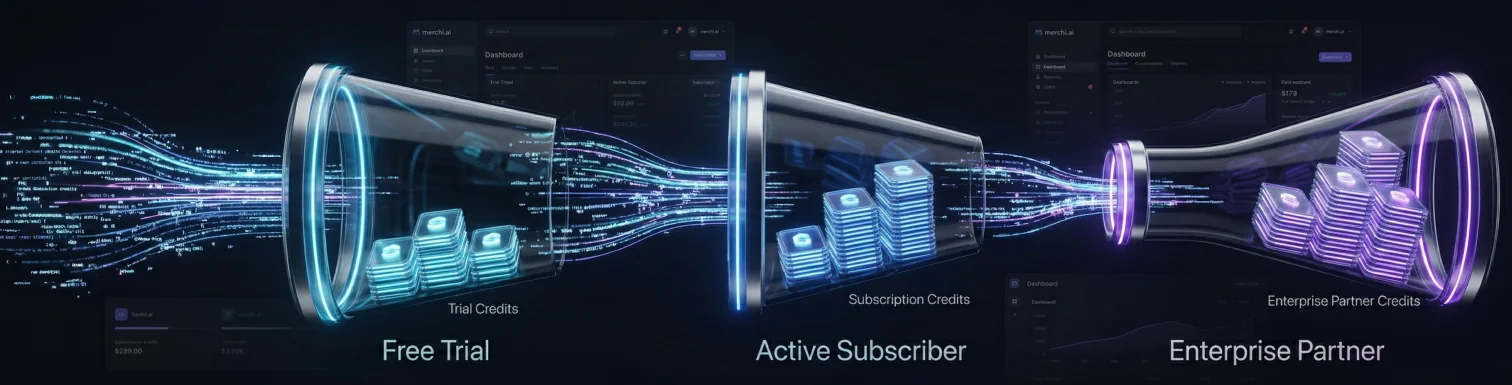
Transitioning to a commercial entity required us to rethink the very nature of value in the e-commerce space. We had to move from selling “software access” to selling “outcomes.” In 2026, the market demands Outcome-Oriented Billing. Our customers don’t want a login; they want 10,000 high-converting, brand-aligned, multi-language product listings ready for their storefronts. This realisation led us to the most critical business decision in our journey as a team of two: the implementation of a comprehensive, usage-based credit system.
This chapter is a candid look at the “unsexy” side of building merchi.ai. We will discuss the anxiety of pricing an AI product, the technical complexity of integrating Stripe for dynamic workloads, and the challenge of building an onboarding flow that gets a user to their “Aha!” moment before they lose interest. This is the story of how we turned a collection of high-performance API calls into a sustainable business that powers the next generation of digital retail.
Beyond the Seat: Why Token Economics Win in 2026
Traditional SaaS pricing was built for a world where humans did the work and software merely provided the interface. In that world, more users meant more value. In the AI-driven world of 2026, the value is in the throughput. At merchi.ai, our core value proposition is the massive automation of product data creation. Whether it’s extracting technical attributes from a ZIP file of industrial images or generating culturally nuanced styling advice for a fashion collection, the cost to us and the value to the customer is directly tied to the volume of data processed.
We opted for a Credit-Based Economy. In this model, every operation within merchi.ai; every vision extraction, every multi-language variant, and every SEO metadata generation consumes a specific number of credits. This approach aligns our costs with our revenue perfectly. Since our AI providers charge us per token, charging our customers per credit ensures that our unit economics remain healthy even as they scale. It also provides our customers with total transparency; they only pay for the merchandising work they actually perform.
However, designing this system required a deep dive into “Pricing Psychology.” We had to decide what a credit was actually worth. If we made the system too expensive, we would alienate the mid-market retailers who need us most. If we made it too cheap, the variable costs of high-reasoning models (like those we use for our “Writing Knowledge” logic) would eat our margins. We spent weeks modelling different scenarios, trying to find the “Goldilocks zone” where a credit felt valuable enough to respect but cheap enough to encourage massive bulk uploads.
One of the secondary trends of 2026 is Usage-Based Transparency. Customers now expect real-time dashboards showing exactly how their credits are being spent. In the merchi.ai dashboard, we provide a granular breakdown of credit consumption. A user can see that a specific “Run” of 5,000 products consumed X credits. This transparency builds trust and allows merchandising managers to justify their budgets to their finance departments with cold, hard data.
The Technical Headache of Billing: Stripe and the Edge Cases
Integrating a billing system sounds straightforward in a tutorial, but in a production multi-tenant SaaS, it is a labyrinth of edge cases. We chose Stripe as our financial backbone, but the integration went far beyond a simple “Buy Now” button. We had to architect a system that could handle the entire subscription lifecycle: from the initial trial period to active subscriptions, past-due states, and the eventual (and hopefully rare) cancellation.
The real complexity lies in the Prorated Usage and Overage logic. In merchi.ai, a customer might start on a “Pro” plan with 10,000 monthly credits but suddenly need to launch a new 50,000 SKU catalogue. We had to build logic that allows for “Top-ups” and automated overage billing. If a Trigger.dev worker is halfway through a massive ZIP upload and the tenant runs out of credits, what happens? We decided against a “hard block,” which would ruin the user experience. Instead, we implemented a “Grace Period” system where the job continues, but the user receives a modal warning and an automated Stripe invoice for the overage.
Handling “past_due” states is another critical area. If a corporate credit card fails, we shouldn’t immediately delete the user’s Writing Knowledge or their historical product data. We built a tiered “Degradation of Service” model. First, we restrict the ability to start new “Runs.” Then, we limit API access, and finally, after 30 days of non-payment, we move the tenant to a “Hibernation” state. This level of automation in the billing logic is what allows a small team to manage hundreds of paying customers without needing a dedicated accounts-receivable department.
We also had to be thoughtful about Feature Gating. Not every customer needs our advanced “Workflow Approval” system or our full “Web Scraping” suite. We used our Supabase database and RLS policies to enforce feature access based on the Stripe subscription tier. This creates a natural “Up-sell” path. A user might start on the “Basic” tier for simple title and description generation, but as they grow and require multi-language variants and enterprise-grade approval workflows, they are nudged toward the higher-tier packages.
The ‘Aha!’ Moment: Engineering an Onboarding Flow that Converts
You can have the best AI merchandising engine in the world, but if your onboarding flow is clunky, you will never convert a trial user into a paying customer. In 2026, the window of a user’s attention is smaller than ever. We call this the 90-Second Aha! Rule. From the moment a user signs up for merchi.ai, we have approximately 90 seconds to show them the “Magic”: the moment where they see a raw image of their product transformed into a professional, brand-aligned listing in three languages.
Our onboarding flow is designed to minimize friction. Instead of asking for a complex “Writing Knowledge” configuration upfront, we encourage the user to upload a single image. We use a “Contextually Genearted Brand Voice” to show them an immediate result. Once they see the quality of the output, they are far more willing to invest the time in configuring their specific taxonomy and tone of voice. This “Value-First” onboarding is what drives our conversion rates from free-trial to paid-subscription.
As an enterprise-focused tool, we also realised that our “Aha!” moment for a retail manager is different from that of a solo founder. For the manager, the magic is in the Workflow and Approval System. In our “Enterprise” tier, we introduced a status-based lifecycle: pending -> in_review -> approved. This allows a senior merchandiser to review the AI’s work before it is synced to their Shopify or WooCommerce storefront. Showing this governance capability during a demo is often the turning point that leads to a corporate contract.
Vulnerability and Pivots: What We Got Wrong About Pricing
Being honest in a building-in-public series means admitting when you got it wrong. Our first attempt at pricing merchi.ai was a disaster. We initially tried a “Flat-Fee” model, thinking it would be simpler for customers to understand. Within two weeks, a large electronics retailer signed up and uploaded 40,000 technical SKUs. Because we were paying for high-reasoning vision models on a per-token, that one customer cost us more in API fees than their entire monthly subscription was worth.
We had to pivot quickly to the Credit System we use today. It was a painful conversation to have with our early adopters, but it was a necessary one for the survival of the business. We learnt that with AI products, you cannot decouple your pricing from your underlying compute costs. The volatility of the model market (as discussed in Chapter 3) means your margins can shift overnight. Usage-based pricing is the only way to remain anti-fragile.
We also struggled with the “Freemium” question. Should we offer a free tier? In the end, we decided on a “Credit-Limited Trial” instead. Providing a truly free tier in 2026 is dangerous for a small team, as it attracts “token-burning” bots and users who aren’t your target audience.
The anxiety of pricing never truly goes away. We are constantly tweaking our packages and feature gates based on customer feedback. But by building a system that is transparent, usage-based, and outcome-oriented, we’ve created a business model that scales alongside our technology. We aren’t just selling a tool; we are selling the ability to launch products at a speed that was previously impossible for even the largest retailers.
Conclusion: The Business of Building
Moving from a technical prototype to a revenue-generating business is the ultimate test for any founder. For merchi.ai, it meant embracing the complexity of token economics, mastering the intricacies of Stripe, and engineering an onboarding experience that proves value in seconds. We’ve built an infrastructure that respects the scale of the 2026 retail market while maintaining the lean efficiency of a team of two.
We have now covered almost every aspect of the merchi.ai journey: from the initial “Invisible Friction” to the “Native Generation” of global content, and finally, the business of billing. In our final chapter, we will wrap up this series by looking at the road ahead. We will discuss the mistakes we’d avoid if we were starting over today and the roadmap for the future of merchi.ai as we continue to redefine what is possible in the world of automated merchandising.
Ready to see why the world’s leading retailers are switching to usage-based merchandising? Book a Demo or Start Automating with merchi.ai.