
merchi.ai vs ChatGPT for Product Descriptions: Why Retailers Switch
Many retailers start with ChatGPT. It is free, it is fast, and it can produce a readable product description from a name and a few specs in seconds. For a small catalogue, it works well enough that teams build habits around it: copy, paste, tweak, publish, repeat.
Then the catalogue grows. Fifty products becomes five hundred. Five hundred becomes five thousand. And the process that felt like a productivity win starts to look like a bottleneck.
This post explains what ChatGPT is genuinely useful for in retail product content, where it runs out of road, and what a purpose-built retail AI platform does differently. The argument is not that one tool writes better prose than the other. It is that they solve different problems, and at catalogue scale, the difference matters operationally.
What ChatGPT is actually good at for product content
ChatGPT is a capable language model. For certain product content tasks, it is a legitimate choice:
Writing a single description. Give it a product name, a few specs, and a tone instruction, and it will produce a readable, accurate description quickly. For a one-off job, this works.
Tone experimentation. Testing different brand voices before committing to a template is fast and low-cost in a chat interface. You can iterate in real time.
Occasional rewrites. Ten product pages ahead of a seasonal sale or new collection? ChatGPT handles that comfortably with minimal setup.
Ideation. Generating bullet point options, headline drafts, or meta description variations when you are starting from scratch is a natural fit for a conversational model.
For catalogues under fifty products, or for teams that update content rarely, ChatGPT is a sensible starting point. The case for switching is not that it produces poor output. It is that it was not built for the operational demands of retail merchandising.
Where ChatGPT breaks down at retail catalogue scale
The problems emerge when the catalogue grows and the manual overhead compounds.
There is no batch processing. ChatGPT processes one conversation at a time. Scaling to a full catalogue requires a custom engineering layer: a script to feed products in, a prompt template for every call, a pipeline to collect outputs, and error handling for failures. That is a software project, not a productivity tool.
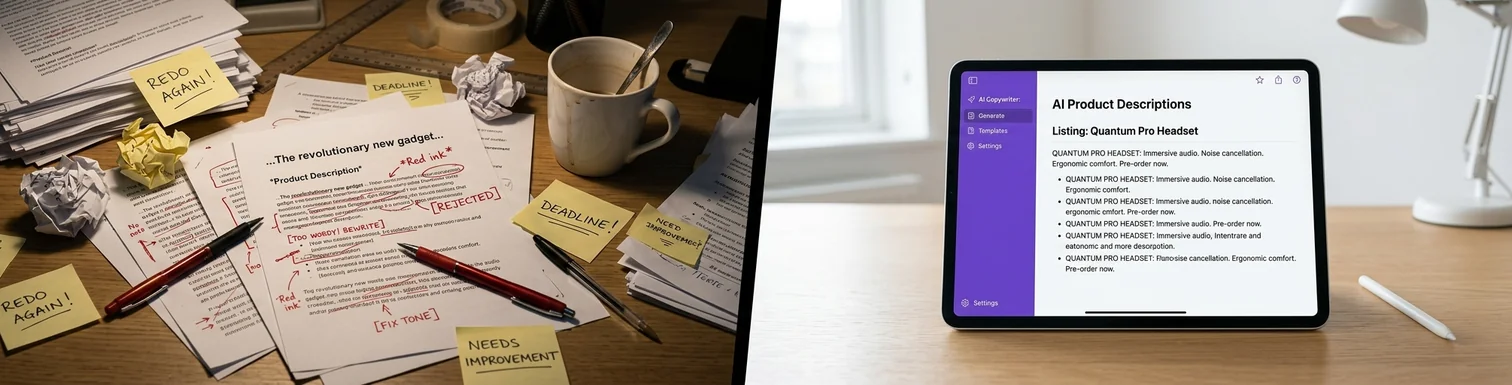
Consistency degrades across runs. Ask ChatGPT to produce five hundred descriptions using the same brand voice and attribute structure, and the outputs will drift. The hundredth product will be formatted differently from the first. Attribute fields will be named inconsistently. Some descriptions will be 80 words; others 200. Each conversation starts with no memory of the previous one.
Image processing does not scale. ChatGPT can analyse an image pasted into a single conversation. It has no mechanism for processing a ZIP file of 500 product images consistently, applying your schema to each one, and returning structured output for every item.
Taxonomy classification is not built in. Classifying products into Google Product Taxonomy, Shopify Taxonomy, or ETIM requires structured logic that ChatGPT does not apply automatically. To do this at scale, you would need to engineer the classification into every prompt and verify each result manually. See how automated product classification works when the logic is built into the platform.
The output is prose, not structured data. A retail catalogue needs more than readable text. It needs filled attribute fields, taxonomy codes, meta titles, meta descriptions, and import-ready records. Converting ChatGPT’s prose into structured data suitable for a Shopify or WooCommerce import is a manual step that adds time and introduces error at scale.
Brand voice erodes without persistent memory. Without a live record of your brand guidelines, approved terminology, and stop words applied to every run, outputs drift over time. Pasting your brand guide into every prompt is not a reliable system for thousands of products.
What a purpose-built retail AI platform adds
merchi.ai is built around the operational reality of retail merchandising. It is not a better version of ChatGPT. It is a different category of system.
Batch processing at catalogue scale. Upload a spreadsheet or a ZIP of product images. The platform processes your entire catalogue in a single pipeline run, applying a consistent configurable schema to every product. The same standard applies to the first product and the ten-thousandth.
Native multimodal input. Product images are a first-class input. The platform reads image content, identifies attributes, and generates structured descriptions and lifestyle imagery without a human prompting each one individually. This is covered in more detail in our AI product description generator guide.
Schema-driven consistency. Every product is processed against the same attribute model. Writing knowledge assets store your brand voice, terminology, and stop words, and they are applied to every run automatically. Consistency is structural, not prompt-dependent. This context layer is also what prevents the output from becoming generic AI copy that AI shopping agents cannot cite or recommend.
Standards Packs for taxonomy classification. Standards Packs apply Google Product Taxonomy, Shopify Taxonomy, and ETIM classification during content generation. No custom engineering required. The codes are embedded in the structured output.
Structured output, ready for import. The platform generates filled attribute fields, taxonomy codes, SEO meta content, and records formatted for direct import. There is no manual conversion between AI output and catalogue update.
Direct integration. Outputs connect with Shopify, WooCommerce, and Magento via API or structured CSV. The full comparison of AI tools for ecommerce product content covers how this compares to other platform approaches.
Responsible AI attribution. Every content run is logged under the AI Provenance Protocol, an open standard that records how each piece of content was generated and under which parameters. This supports EU AI Act compliance and gives retailers an auditable content trail.
One UK flooring retailer used this approach to clear a 1,000-product backlog without adding headcount. Products that had generated zero organic traffic became their highest-converting pages after AI-generated content was deployed, contributing to 976% online revenue growth. See the case study.
Comparing the two approaches
| Capability | ChatGPT | merchi.ai |
|---|---|---|
| Write a single product description | Yes | Yes |
| Batch process 1,000+ products | Manual, no pipeline | Automated batch |
| Generate from product images | Limited, one at a time | Native multimodal input |
| Apply custom attribute schema | Manual prompt engineering per product | Schema-driven, consistent |
| Taxonomy classification (Google, Shopify, ETIM) | Not natively | Standards Packs |
| Direct Shopify/WooCommerce integration | No | Yes (API and CSV) |
| Brand voice consistency at scale | Inconsistent without fine-tuning | Knowledge assets applied per run |
| Responsible AI attribution (EU AI Act) | No | AI Provenance Protocol |
When to use each
This is not a claim that one tool produces better writing than the other. They solve different problems at different scales.
Use ChatGPT for product content when:
- Your catalogue has fewer than fifty active products
- You are testing a new tone or format before committing to a template
- You need a quick refresh of a handful of pages ahead of a promotion
- You have in-house engineering resource to build and maintain a custom pipeline
Use a purpose-built retail AI platform when:
- Your catalogue runs to hundreds or thousands of SKUs
- You need consistent structured output for catalogue import, not just readable prose
- Product images are your primary data source
- You need taxonomy classification built in and reliably applied
- You are operating across multiple markets or languages
- You need a compliant, auditable AI content process
For teams already using tools like Jasper and finding the same limitations, the switching from Jasper guide covers what that transition looks like in practice.
The distinction matters because the wrong tool at the wrong scale does not just slow you down. It creates inconsistencies across your catalogue that accumulate over time and affect search visibility, customer confidence, and operational workload.
If you are currently using ChatGPT for product content and finding the manual overhead growing, the question is not whether a specialist platform is better. It is whether your catalogue has reached the scale where the operational benefits justify the switch. For most retailers with more than a few hundred products, it already has.
Ready to see what a purpose-built retail AI platform does with your catalogue? Start a 30-day free trial or explore the merchi.ai platform.
Frequently Asked Questions
Can ChatGPT write product descriptions as well as merchi.ai?
For a single product, ChatGPT can produce a good description quickly. The difference is not quality at the individual level. It is consistency, structure, and scale across a full catalogue. merchi.ai applies the same schema, brand voice, and attribute model to every product in a batch, which requires significant custom engineering to replicate with ChatGPT.
How does merchi.ai handle product images differently from ChatGPT?
merchi.ai accepts bulk image uploads and processes every product image through a multimodal pipeline automatically. ChatGPT can analyse an image pasted into a single conversation, but has no mechanism for batch image processing. The AI product description generator guide walks through how image-to-content generation works at catalogue scale.
Does merchi.ai integrate directly with Shopify or WooCommerce?
Yes. merchi.ai outputs structured data formatted for direct import via API or CSV. ChatGPT outputs prose text, which requires a manual step to convert into the structured fields that Shopify or WooCommerce expect. The full comparison of AI tools for ecommerce product content includes integration as a key evaluation criterion.
What is a Standards Pack and does ChatGPT have anything equivalent?
A Standards Pack in merchi.ai applies a recognised taxonomy (Google Product Taxonomy, Shopify Taxonomy, or ETIM) automatically during content generation. Every product is classified consistently and the codes are embedded in the structured output. ChatGPT has no equivalent capability built in. For a detailed explanation, see our post on automated product classification.
Is merchi.ai suitable for retailers switching from Jasper or other AI writing tools?
Yes. The switching from Jasper guide covers what the transition looks like and what to expect from the first catalogue run. The core difference is the same as with ChatGPT: general-purpose AI writing tools produce prose, while merchi.ai produces structured, schema-consistent product data.
What is the AI Provenance Protocol and why does it matter for retailers?
The AI Provenance Protocol is an open standard that records how AI-generated content was produced, by which model, and under which parameters. This creates an auditable content trail relevant to EU AI Act compliance. ChatGPT has no equivalent attribution mechanism. Read more about what the AI Provenance Protocol is and how it works.